
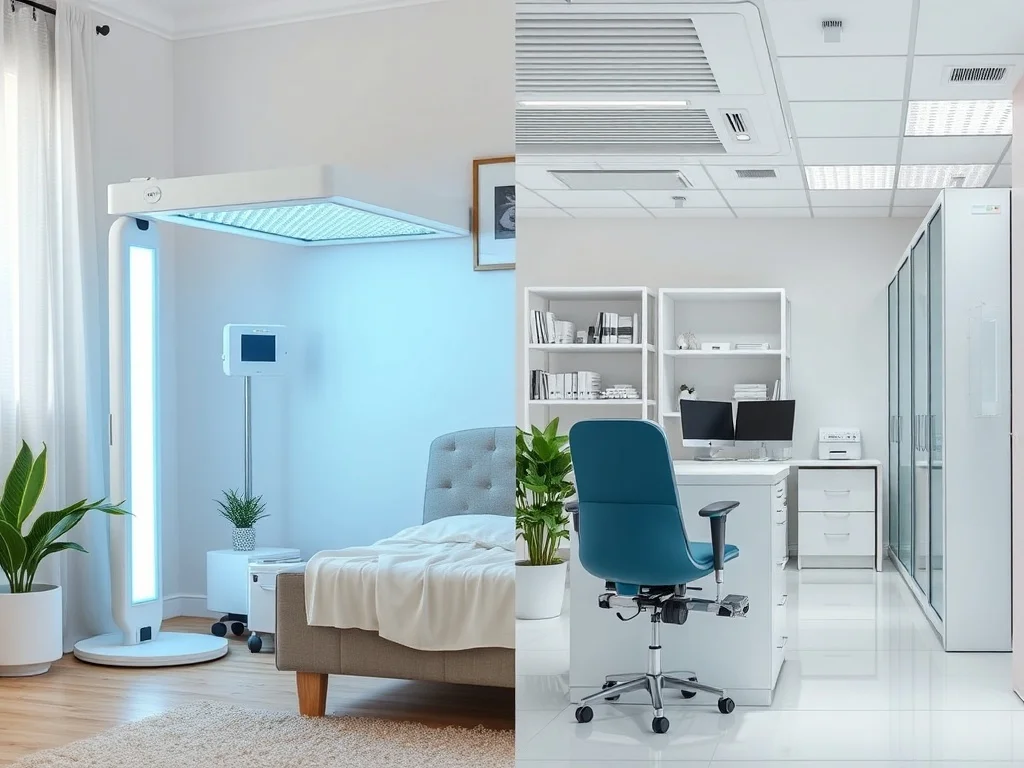
Home UVB vs. In-Clinic Phototherapy: Cost and Convenience Compared
Both home and in-clinic NB-UVB phototherapy use the same clinically effective wavelength. The decision between them usually comes down to cost, convenience, and consistency — not effectiveness. Here’s how those actually compare.
The cost math
In-clinic phototherapy typically means a copay or out-of-pocket fee per visit, three to five times a week, for a treatment course that commonly runs six months or longer. Even a modest per-visit cost adds up fast at that frequency — a $30 copay three times a week comes to roughly $360 a month, or well over $2,000 across a six-month course.
A home device is a larger single upfront cost, but budget devices start well under $300, and even a higher-end panel from Daavlin, Kernel, or Dermfix is often cheaper than a full course of in-clinic visits once you account for the ongoing per-session cost. For patients without insurance coverage for phototherapy specifically, home devices tend to be the more economical path over any treatment course longer than a couple of months.
The convenience math
In-clinic treatment requires getting to an appointment three to five times a week, which is a real logistical burden — traffic, parking, work schedules, and simple travel time all compound over a months-long course. This is one of the most common reasons patients report inconsistent treatment: not lack of commitment, but the practical difficulty of getting to a clinic that often.
Home treatment removes that barrier entirely. Sessions happen on your schedule, without travel time, which tends to translate into better long-term consistency — and consistency is one of the biggest drivers of NB-UVB results.
Where in-clinic still has real advantages
Professional dose calibration. A clinic team can do a proper minimal erythema dose (MED) test and adjust your protocol in person as your skin responds — something you have to manage more independently at home, ideally still with dermatologist guidance.
No upfront equipment cost or responsibility. If you are not sure yet whether you will commit to a long-term phototherapy routine, starting in-clinic avoids spending on a device before you know if the treatment and the routine work for you.
No device maintenance. Bulbs degrade over time and need replacement; clinic equipment is professionally maintained, which is one less thing for you to track.
A reasonable way to decide
Many dermatologists suggest starting in-clinic for the first few weeks — to establish a safe, calibrated starting dose under supervision — then transitioning to a home device for the long-term maintenance phase once your protocol is established. This gets you the calibration benefit of in-clinic treatment without the months of ongoing travel and cost.
My take
If cost or logistics are the barrier keeping you from starting phototherapy at all, a home device is very likely the more sustainable long-term choice for most patients. If you are still deciding whether NB-UVB is right for you, starting in-clinic to test the treatment before investing in equipment is a reasonable, lower-commitment first step.
